
How ABS Brakes Work and Why They Can Save Your Life

Imagine you're driving on a wet road.
A child suddenly runs across the street.
You slam on the brake pedal as hard as you can.
Without the right braking system, your wheels could lock up, causing your car to slide uncontrollably.
This is exactly the problem Anti-lock Braking Systems (ABS) were designed to solve.
Today, ABS is one of the most important safety features found in modern vehicles.
But how does it actually work?
What Is ABS?
ABS stands for Anti-lock Braking System.
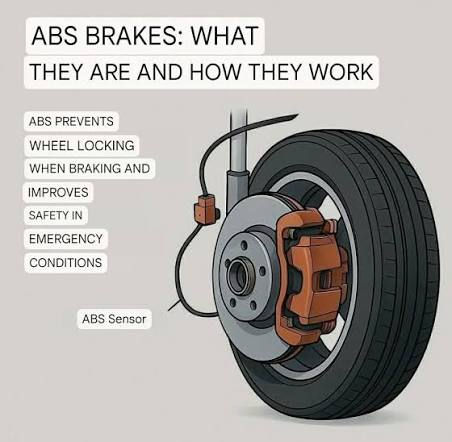
It is a safety system that prevents your wheels from locking during hard or emergency braking.
Instead of allowing the tires to stop rotating completely, ABS rapidly adjusts the braking pressure many times per second.
This helps the tires maintain grip on the road.
Why Do Wheels Lock Up?
When you brake too hard, especially on slippery roads, the tires can stop rotating while the car is still moving.
When this happens:
The vehicle begins to slide.
Steering becomes difficult or impossible.
Stopping distance may increase on many road surfaces.
You lose much of your ability to avoid obstacles.
ABS helps prevent this from happening.
How Does ABS Work?
ABS constantly monitors the speed of each wheel using wheel speed sensors.
If it detects that one or more wheels are about to lock, the system:
Reduces brake pressure to that wheel.
Allows the wheel to rotate again.
Reapplies brake pressure.
Repeats this process many times every second.
The result is controlled braking while maintaining steering ability.
You may feel the brake pedal vibrate during this process.
This is completely normal.
What Does the ABS Warning Light Mean?
When you start your car, the ABS warning light usually comes on briefly before turning off.
If it stays on while driving, it may indicate a problem with the ABS.
Possible causes include:
Faulty wheel speed sensor
Damaged wiring
ABS control module fault
Hydraulic system issues
Your regular brakes may still work, but the anti-lock feature may not be available.
Have the system inspected as soon as possible.
Does ABS Reduce Stopping Distance?
Many people believe ABS always makes a car stop in a shorter distance.
That's not entirely true.
On most paved roads, ABS can help drivers maintain control while braking and may reduce stopping distances.
However, on loose surfaces such as gravel or deep snow, stopping distances can sometimes be longer because locked wheels can build up material in front of the tires.
The greatest advantage of ABS is maintaining steering control, not simply stopping faster.
Should You Pump the Brake Pedal?
If your car has ABS:
No.
Press the brake pedal firmly and keep it pressed.
The ABS automatically pulses the brakes for you.
Pumping the pedal yourself can reduce the system's effectiveness.
Older vehicles without ABS may require different braking techniques.
Can ABS Prevent Every Accident?
No.
ABS is a valuable safety feature, but it cannot overcome the laws of physics.
It cannot compensate for:
Driving too fast
Worn tires
Poor road conditions
Following other vehicles too closely
Safe driving habits remain essential.
How Do You Know If Your Car Has ABS?
Most modern vehicles come equipped with ABS.
You can usually confirm this by:
Looking for the ABS warning light when starting the vehicle.
Checking your owner's manual.
Reviewing the vehicle specifications.
If you're buying a used car, it's worth confirming that the ABS system is present and functioning correctly.
Tips for Keeping Your ABS Working Properly
While ABS requires little routine maintenance, you can help keep it functioning by:
Keeping your brake system properly serviced.
Replacing worn brake components when needed.
Maintaining correct tire pressure.
Addressing ABS warning lights promptly.
Avoiding modifications that affect the braking system.
A healthy brake system gives ABS the best chance to perform when you need it most.
Santonis Insight
ABS is one of those features you may never think about—until the day it saves you from losing control.
It's not designed to let you drive more aggressively.
It's designed to help you stay in control when unexpected situations arise.
Understanding how it works can make you a more confident and safer driver.
Final Thoughts
The Anti-lock Braking System is one of the most important safety innovations in modern vehicles.
By preventing wheel lock-up, it helps drivers maintain steering control during emergency braking and reduces the risk of losing control on many road surfaces.
While ABS is a powerful safety feature, it works best alongside responsible driving, proper vehicle maintenance, and good tires.
Technology can help—but safe driving will always be your first line of defence.
Drive Safer With Santonis
At Santonis Car Catalog, we're committed to helping drivers make informed decisions through practical automotive guides, safety tips, and trusted vehicle knowledge. Whether you're buying your next car or learning how to care for your current one, we're here to help every step of the way.
Comments